




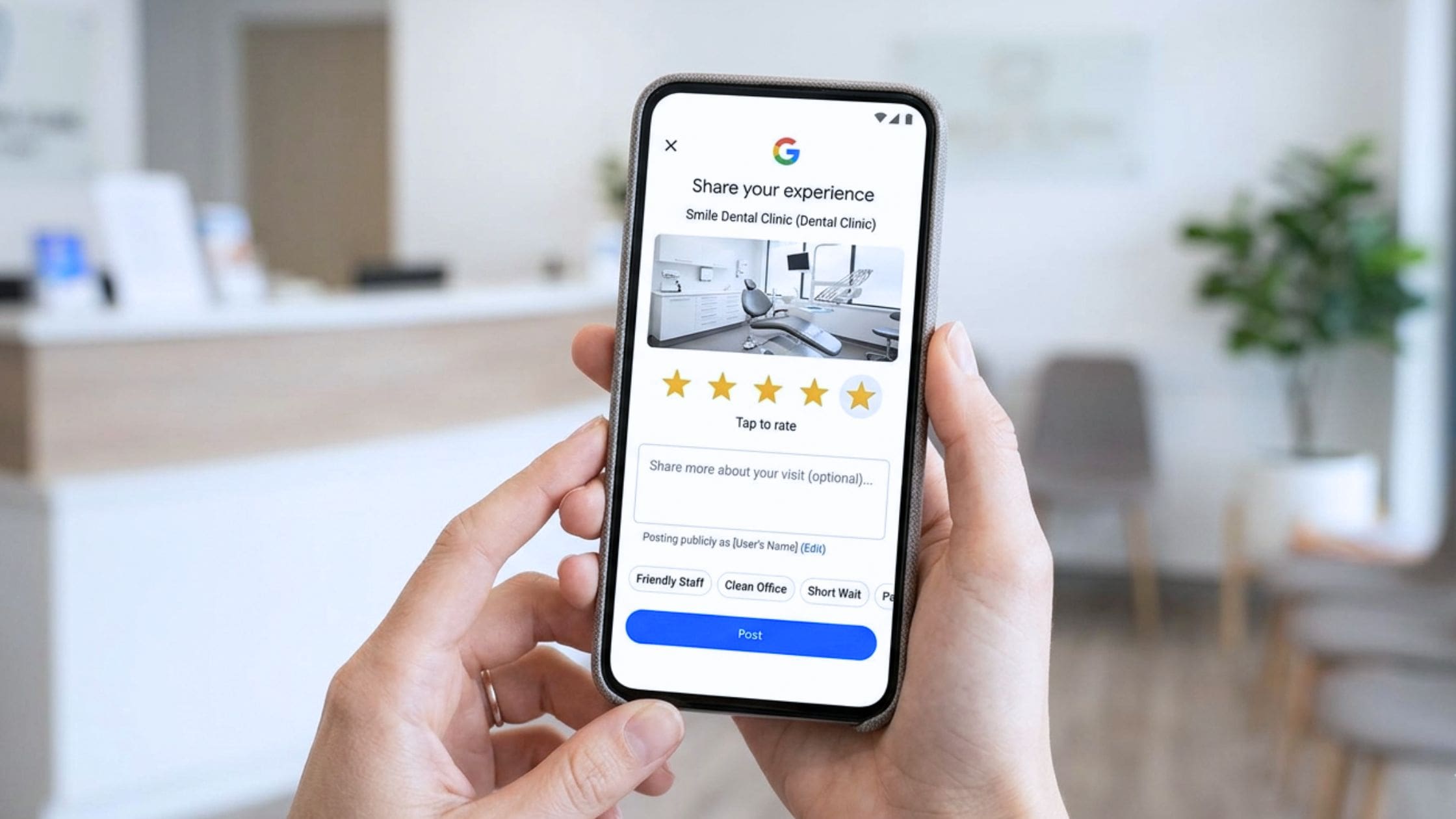
Google reviews are one of the most powerful things a dental clinic can control. They influence where you appear in local search results, whether a patient chooses to call you over a competitor, and how much trust a new patient arrives with before they’ve even met your team.
Most dentists know this. The problem isn’t awareness. It’s that there’s no consistent process for actually getting them.
A clinic that asks every patient, every time, through the right channels at the right moment, will accumulate reviews steadily and compound that advantage over time. A clinic that asks occasionally, or relies on happy patients to leave reviews spontaneously, will stay stuck at the same count for months.
The good news is that building this process is simpler than most practice owners expect. Here’s how to do it.
Why Most Clinics Struggle to Get Reviews
Before getting into the how, it’s worth understanding why the asking doesn’t happen consistently.
The most common reason is that it feels awkward. Asking a patient to leave a review at the end of an appointment, particularly after a clinical procedure, doesn’t come naturally to most dentists or front desk teams. It can feel like asking for a favour, or worse, like you’re more interested in your own profile than in the patient’s wellbeing.
The second reason is inconsistency. Even in clinics where asking is encouraged, it depends on individual team members remembering to do it, feeling comfortable doing it, and finding the right moment in a busy handover. That inconsistency means some patients get asked and most don’t.
The third reason is friction. If asking for a review means explaining to a patient how to find your Google Business Profile, search for your clinic, click the review button, and then write something, most patients who meant to leave a review simply won’t get around to it.
The easier you make the action, the more people will complete it.
A good review process removes all three of these barriers.
Start Here: The QR Code and Tap-to-Review
If your clinic has no review process in place right now, this is where to start. It costs almost nothing, requires no software, and can be implemented this week.
A QR code linked directly to your Google review page, printed and placed at your front counter, removes almost all friction from the in-person ask.
When a patient is checking out, your receptionist can say: “We’d love it if you had a moment to leave us a Google review — you can scan that code right now and it takes about a minute.”
The patient pulls out their phone, scans the code, and lands directly on your Google review prompt. No searching, no navigating, no forgetting to do it later.
For an even smoother experience, a tap-to-review device at the counter uses NFC technology, the same technology behind contactless payments, so a patient simply taps their phone to the device and the review page opens instantly.
It’s a small detail but it removes even the step of opening a camera to scan a code, and it tends to generate comments from patients who wouldn’t have thought to leave a review unprompted.
Both options work best when paired with a brief, genuine verbal ask from your front desk team. The technology lowers the friction. The human moment creates the motivation.
The Timing That Makes the Difference
When you ask matters as much as how you ask.
The best moment to request a review is when a patient is feeling positive about their experience — at checkout after a smooth appointment, or a few hours later when the experience is still fresh but they’ve had a moment to settle.
Asking during the appointment itself is too early. Asking days later is too late — the emotional peak has passed and the review request feels like an admin task rather than a natural response to a good experience.
For routine checkups and hygiene appointments, the checkout moment is ideal.
For more significant treatment, a follow-up message a few hours after the appointment often works better — it gives the patient time to feel the relief or satisfaction of the outcome before you ask them to reflect on it.
Automating the Ask Through EXACT
For clinics using EXACT, the review request process can be automated so that it happens consistently after every appointment without relying on your team to remember.
EXACT can be configured to trigger a post-appointment SMS or email at a set interval after a patient is checked out.
That message thanks the patient for attending and includes a direct link to your Google review page. Because it goes out automatically, every patient gets asked, not just the ones whose appointments ended on a particularly good note or whose receptionist happened to remember.
The message itself should feel personal, not automated.
A short, warm SMS that uses the patient’s first name and references that they’ve just had an appointment performs significantly better than a generic “please leave us a review” template.
The link should go directly to the review prompt, with no intermediate steps.
Consistency is what builds review volume over time. An automated sequence through EXACT delivers that consistency without adding anything to your team’s workload.
Automating Through GHL for Ignite Clients
For clinics working with Ignite whose marketing includes our GHL CRM platform, the same automation is built into your setup from day one.
GHL allows for more sophisticated review request sequences than a single post-appointment message.
A patient who doesn’t respond to the first SMS can receive a follow-up email a few days later. The timing, channel, and message content can be refined based on what’s working for your specific clinic and patient base.
GHL also connects your review activity to the rest of your marketing data, so you can see the relationship between your review volume, your Google ranking, and your new patient enquiries over time.
That visibility helps you understand the return on the effort and makes the case for keeping the process active.
What the Message Should Actually Say
The content of the review request matters. A message that feels genuine and low-pressure will convert far better than one that feels like a marketing template.
A Few Principles That Hold Up Consistently
- Keep it short. A two or three sentence SMS is more likely to be read and acted on than a long email. Get to the point quickly.
- Use the patient’s name. Personalisation signals that this is a genuine message, not a bulk send.
- Make it easy. The link should open the review prompt directly. Don’t ask patients to search for you.
- Don’t offer incentives. Offering discounts or rewards in exchange for reviews violates Google’s guidelines and can result in reviews being removed or your profile being penalised.
Genuine, unprompted reviews are what Google rewards.
A Simple Example That Works Well
“Hi [First Name], thanks for coming in today. If you have a moment, we’d really appreciate a Google review — it helps other patients find us. Here’s the link: [direct review link]. Thank you.”
That’s it. No lengthy explanation, no multiple asks in one message, no pressure. Just a warm, direct request with a frictionless path to action.
Responding to Every Review
Getting reviews is only half of the process. How you respond to them is the other half, and it’s where many clinics leave value on the table.
Responding to every review, positive and negative, signals to Google that your profile is active and engaged, which supports your local ranking.
It also signals to prospective patients reading your reviews that your clinic is attentive and professional.
A response to a positive review doesn’t need to be long. A genuine thank you that references something specific about what the patient mentioned takes thirty seconds and makes a meaningful impression on anyone reading it.
A response to a critical review requires more care. Acknowledge the patient’s experience without being defensive, express that you’d like to understand more, and invite them to contact you directly.
A well-handled critical review can actually build more trust than a page of five-star ratings because it shows how your clinic behaves when things don’t go perfectly.
The Compound Effect of Consistency
One review a week is 52 reviews a year. Two reviews a week is over a hundred.
A clinic that asks consistently and makes the process frictionless will outpace a competitor who relies on spontaneous reviews, regardless of which clinic actually delivers the better clinical experience.
Google’s algorithm weights recency heavily. A steady flow of recent reviews signals that your clinic is active, trustworthy, and popular.
A large number of older reviews with nothing recent tells a different story.
The clinics that dominate local search in competitive markets aren’t necessarily the ones with the highest scores. They’re the ones with the most consistent review activity over time.
Building that consistency is a process decision, not a luck one.
Getting Started
If your clinic doesn’t have a review process in place, the fastest starting point is a QR code at the counter and a brief verbal ask at checkout.
You can have that running today.
If you want to automate it through EXACT or build it into a wider marketing and CRM system, that’s a conversation worth having.
Either way, the sooner the process is in place, the sooner the reviews start compounding.